Like starting anything new, sometimes taking the first step is the hardest. This is often due to the overwhelm of new information and the unknown. Gardening with native plants is no exception and it can come with a huge learning curve. The beauty of Wild Ones is that we can come together and learn from each others successes and failures.
This page offers some resources to help get you started on going native with your landscape!
Prep the Site
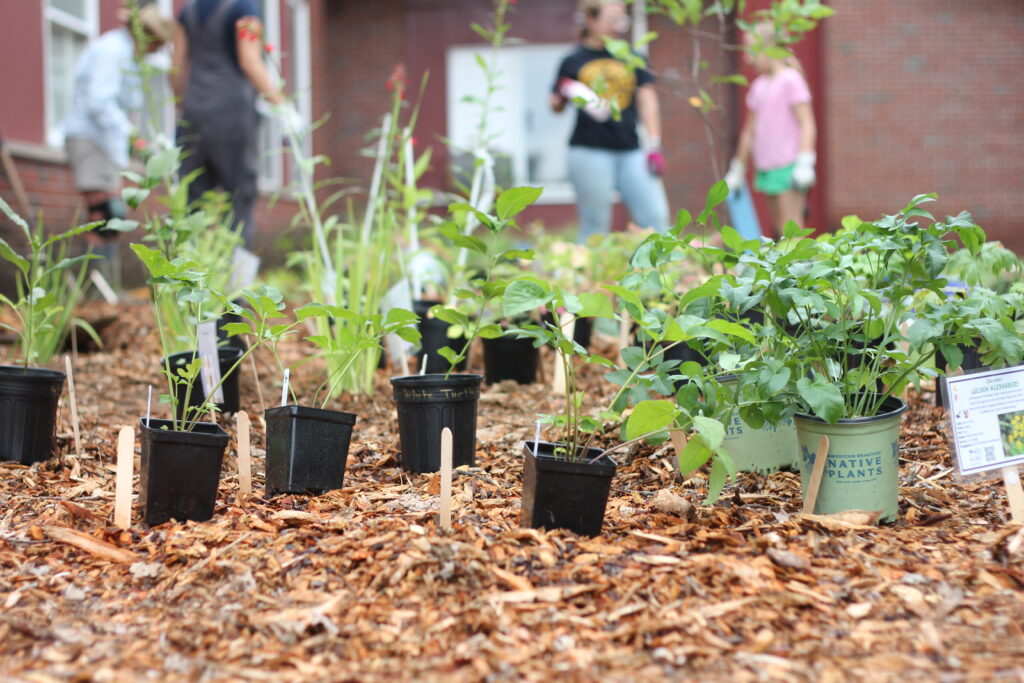
Prepping for a new garden is cruicial to minimizing unwanted weeds. There are a few options to do this:
- Smother
- Cut sod
- Cultivate
Details for these techniques, as well as other tips, can be found at Grow Native! and Prairie Nursery.
Purchasing Native Plants and/or Seeds
1. When selecting what kind of natives you put into your garden, you first need to assess the growing conditions of the garden. To do this you first need to consider is your soil type; the moisture level of the soil; and the sun exposure.
Soil Types
There are three basic soil types: clays, loams, and sands.
- Clay: If you have standing water for a long period of time after a heavy rain, you likely have clay. Clay abosorbs water very slowly, and therefore drains very slowly. Once it is dry however, it is hard and can crack.
- Loamy: This is when your soil is a combination of sand, silt, and clay. Typically moist.
- Sand/Gravel: Extremely well drained and dry.
If you aren’t sure, an easy way to check your soil is to do a Mason Jar Soil Test.
For a slightly less scientific way to check your soil type, you can simply grab a handful of moist soil and squeeze it into a ball.
- If it holds its shape, but crumbles easily when you poke it, you have loamy soil.
- If it crumbles and falls apart immediately, it is sandy.
- If it stays tightly compacted in a dense, sticky, or slimy ball, it’s mostly clay.
Moisure
- Dry soils – Extremely well-drained
- Medium soils – also called mesic soils sometimes experience standing water, but only for short periods, such as after a heavy rain
- Moist soils – Regularly damp, only has standing water for short periods
- Wet soils – Remain damp year-round and may have standing water for long periods
Sunlight
- Shade: Less than 4 hours of sun per day
- Full sun: 6+ hours of sun per day
- Partial sun: 4-6 hours of sun per day
2. Next the focus should be selecting plants that are native to your region and hardiness zone.
When using sites such as Prairie Nursery, you are able to search plants native to your state (as well as your site conditions) by using the filter on their site.
The Wisconsin DNR also offers lists of native plants on their site as well. One such list is Native Plants for Beginners and another is Wisconsin Native Plants: Recommendations for Landscaping and Natural Community Restoration. Check out the table of contents to search plants by soil type.
3. Choose ethically sourced plants and seeds. Prairie Nursery and Prairie Moon Nursery are great online sources for native plants and seeds. The DNR also provides a list of Wisconsin Native Plant Nurseries.
Resources:
Wisconsin DNR: Getting Started with Native Plants
From the Wild Ones Local Ecotype Guidelines:
…Beware of plant material dug from the wild or plants which are “nursery grown” in
pots after being dug from the wild. Plants should instead be “nursery propagated”
from seed or cuttings, not collected from the wild. It is environmentally unethical
and contrary to the mission of Wild Ones to buy plants dug from our last remaining
natural areas in order to naturalize your yard.
Ask for seedling stock, not clonal stock, nativars, cultivars or horticulturally
enhanced plants. Clonal stock, nativars, cultivars and horticulturally enhanced
varieties lack genetic variation. They are usually selected for bigger, showier
flowers or more sturdy stems and this goal of aesthetic uniformity is at the expense
of genetic diversity. Cultivars and horticulturally enhanced varieties are often
propagated asexually and thus are clones rather than unique, genetic individuals.
(A variety of an individual species can be a naturally occurring variety or a
horticulturally produced variety.) Check with local lists of native plants to see if the
varieties are native locally or horticulturally produced.
When collecting seeds, collect from many individual plants from within the same ecotype of
each species (rather than taking seeds only from the biggest plant, for example), and do not
take all the seeds from any plant. This will help preserve and increase the genetic variation of
the population. Also, be sure to get permission for seed collecting; it is not allowed in some
natural areas...